virtualGROGMEET 2023 – Play Report

If you have been paying attention you’ll know that my gaming has taken a thematic thread this year. I have been playing games that use the concept of the multiverse as a setting. This was not planned, I just fell into it backwards like Dr Strange, but without the eye-popping special FX.

There’s no better metaphor the gaming multiverse than virtual GROGMEET.

This is an online convention that we organise every April. This time, there were forty different pocket universes being discovered by over a hundred registered players, who participating from the comfort of their own homes, exploring new worlds, with new people.

Visiting a million-spheres, near to your kettle while sitting in your favourite chair.

The breadth of games on offer is always astonishing. This year in particular included an impressive menu that embraced the traditional to the indy and everything in-between. Since it first begun back in 2017, it has launched many online gaming groups. It remains an encouraging environment to start online GMing as well as introducing different people to … different people.

PLAY IS THE THING

“You’re playing in all of the sessions?” is the puzzled exclamation I usually hear at various points over the virtual GROGMEET weekend. People can’t understand why would sign-up from Thursday to Sunday. I block out the entire weekend and treat it like I have left the house to go to a convention. There’s a sign put on the door that says that I’m ‘in’, but I’m not ‘in’ in – for all intents and purposes I’m in another place, anywhere in the multiverse.

This play report is in the 1d6 format, five highlights and a fumble.

  1. MORECOCK’s MULTIVERSE

The weekend kicked off with the usual Thursday night quiz which was the rematch of the pub quiz from the Moorcock/ Tolkien weekender. Players were invited to choose their side to pit Moorcock knowledge against Tolkien knowledge. Really, you needed to know both to win, as there was twenty-five questions on each. If you want to decide if you are Moorcock or Tolkien, follow the links to test yourself at home.

Moorcock Quiz and Tolkien Quiz

The first of two games I played using Chaosium’s Stormbringer rules was a Hawkmoon game. Someone had breached that most sacred of trust; stealing the very thoughts of the immortal King-Emperor Huron of the Granbretan Empire. The player characters ‘get to the ornithopter’ in an investigation to undercover the conspiracy. The scenario had a fittingly sinister atmosphere which was very evocative of Londra under the Empire.

Designs supplied by @tomtremendously

In the late-night slot (11.00pm – 3.00am) on Saturday night, I was in the Young Kingdoms waiting in Dhakos Harbour as an emissary from Pan Tang delivered gifts to secure an alliance with Jarkor. The player characters were nobles of the court responding to steady corruption of chaos that follows. Beware Pantangians bearing gifts. This was Stormbringer 5th edition rules, a first for me, and it creates characters that are more powerful than the 1st-3rd. It was quite refreshing to be competent, not that it helped against the machinations of Jagreen Lern.

2. PLANESCAPE

Adventuring across the multiverse was not constrained to Moorcock.

Following the last month’s Book Club I have continued to study the Planescape output from TSR in the early 90s. I was told that players tend to stick in the central city of Sigil rather than taking a tour of the planes.

The Great Modron March addresses this by having episodic adventures that follow the the strange clockwork Modrons parading from Mechanus across Outer Planes of the Great Wheel and the gate-towns of the Outlands. They have started their march 150 years too soon. The campaign is made up of eleven wonderfully inventive scenarios, it was a pity that I could only do three of them.

The joy of running games over consecutive nights is the camaraderie it creates among the players. The characters can experience a range of highs and lows over the nine hours of play. The little characterful events that make a game interesting can be called back as they are still fresh in the memory. The exotic sausage shop of Automata was never far away, for example.

When the group finished on the Sunday night, there was a real sense that they would continue adventuring together, following the Modrons on their journey, because they had formed such a strong in-game companionship. Great. Same again next year? Maybe.

3. CALL OF CTHULHU

For the first time in a long time, I’ve not got a regular game of Call of Cthulhu on the go.

A Saturday afternoon session seemed a perfect chance to stay connected to what remains my favourite game. Why is it my favourite? I love the versatility of the setting for creating mood and engaging situations.

Of Sorrow and Clay is a mystery set in the 1920s Appalachian mountains. The Keeper piled on the atmosphere as we explored the disappearance of our Pa who had gone mad in the woods. Despite some discord technical issues, I’d say that this is one of the best Call of Cthulhu sessions that I’ve played in a long time: beautifully constructed, well developed player characters, and an extraordinarily creepy revelation. Highly recommended.

4. DARK CONSPIRACY

Since virtual GROGMEET started back in 2017, its primary aim has been to introduce people to online gaming by providing a supportive place for people to try out new ideas and run games online for the first time. It was great to play with Lee Williams, running his first online game and first convention game.

Ever since I have known Lee I have been interested in his fandom of Dark Conspiracy, GDW’s setting of near future horror. He did a hack using Liminal, as he is a fan of the setting, but not the rules. The post-economic-crash setting is right up my street. We went up a street and ended up in a sinkhole. There were encounters with giant grubs and a weird bunker. We believed we were in a kind of Narnia, but with Abi Titmus standing in for Mr Tumnus in our imaginations. It was a game from the nineties after all.

5. FANZINE BOOKCLUB

The Book Club remains the highlight of my month, so it was good to get an extra in for the virtual GROGMEET weekend. It was a fanzine special looking at two British ‘zines from April 1986. Dead Elf by Andrew Fisher and Runestone by Bill Lucas and our very own Nick Edwards. We were joined by Nick (Quasits and Quasars) and Justin (Drune Kroll), editors from back in the day, who were able to support the discussion with some insider knowledge.

This was a period of the the wild west of FRP zine publishing in the UK, partly driven by cheaper off-set litho printing and the publicity from Imagine magazine’s coverage. The print runs for these zines was very small, most of them given away in exchange for other ‘zines. They were talking to each other: kicking against Games Workshop and TSR for most of the time and rehashing the ‘roll’ gamer and ‘role-gamer’ arguments.

A fascinating discussion and a real step back in time. We are going to do some more ‘zines in future meetings. Dagon is coming soon.

6. There has to be a fumble. We rolled on the table and … a cock-up with the world clock, due to British Summer Time, meant that the interview with Jon Cohen has been postponed. You can find the details here.

virtual GROGMEET is a highlight of the year. This year was no exception. Thanks to GMs who hosted games and the players who brought them to life. Play is the thing.

P.S. Team Tolkien won. This time.

The Fellowship of Welsh Wizzard

Today marks two years since our gaming friend Mike Hobbs passed away. The Welsh Wizzard’s good humour, generous spirit and enthusiasm was infectious and much missed. We tried to continue his spirit by fund-raising in his memory. His friends contributed to buying games for school and youth groups to introduce a new generation to Mike’s hobby.

Cris and Jo Watkins from bonhomie games have done a tremendous job in turning an idea into reality. They have managed the fund and delivered games, lots of games, to the following game groups:

Caldicot Comprehensive School
Knayton Academy
The Zone Youth Club
Together Works Community Centre
Corpus Christi Catholic High School
Archbishop Rown Williams Primary School
Portskewett Youth Club
St Joseph’s School
ACCT Sheffield and Saint Michael’s Gaming Group

They include Primary and Secondary School game clubs, Youth Clubs, a Community Centre, and a charity. There are three of these organisations that support those with Additional Learning Needs including Autism and ADHD.

Each group had an opportunity to shape the package they received. Battletech to Ticket to Ride have been provided, each with a certificate of approval. Cris has kindly provided photographs of some of games being delivered and put into action.

This weekend is virtual GROGMEET, so please raise your dice cup to the memory of The Welsh Wizzard who is still spreading his magic.

Star Frontiers: Where No Dwarf Has Gone Before

As part of the latest GROGPOD, Daily Dwarf turns his attention to Imagine Magazine and how it covered Star Frontiers

“Oi DD, we’re doing Star Frontiers on the next pod, I need 1500 words from you, stat!”

Dirk the Dice, host of The GROGNARD files RPG Podcast

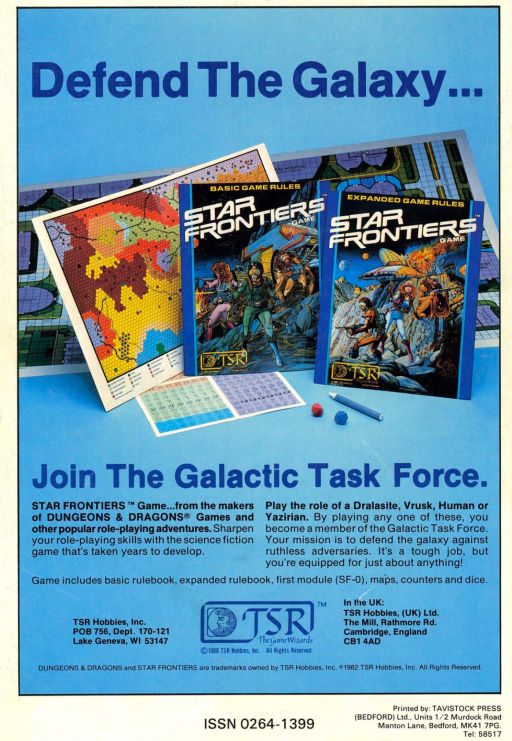
Hmm, the latest assignment from his messianic megalomaniac-ness was going to be a bit of a problem. You see, Star Frontiers hardly featured in White Dwarf magazine. It was reviewed in Open Box, issue #37, where Andy Slack commented that the combat system was “in the heroic style with people missing each other like crack Imperial Stormtroopers”, but also noted that space travel was “virtually ignored”, before giving it a respectable 7 out of 10. Apart from that though, the only time Star Frontiers appeared was in those back-page adverts where TSR cheekily referred to their science fiction RPG as “the ‘playable’ one”. Naughty.

But anyway, what’s a Daily Dwarf to do? Well, it turns out there were other RPG magazines back in the day, and the dangerous combination of lockdown, red wine and ebay has meant I’ve acquired a fair few of them recently.

So, tonight Matthew, I’m going to be… *emerges from swirling dry ice* … Intermittent Imagine!

Imagine, TSR UK’s RPG magazine from the mid-80s, (unsurprisingly) had a decent amount of coverage of Star Frontiers – plenty for us to dig into. I should note at the outset though that I’ve never played Star Frontiers, and don’t really know that much about it apart from its reputation for having an interesting mix of alien races. So, the following comments are made in something of a state of ignorance. But when have I ever let that stop me before?

The game itself was reviewed in the very first issue, where Jim Bambra was broadly positive about the game, noting its emphasis on pulp adventure, while acknowledging the soon-to-be infamous lack of starship rules in the initial boxed set. There were a smattering of module reviews in subsequent issues, and Star Frontiers also put in an occasional appearance in the Dispel Confusion Q&A column, Imagine’s feature for rules lawyers everywhere. Apart from that though, all the Star Frontiers content in the magazine consisted of adventures – this struck me at first glance as a notable contrast with the coverage of Traveller in White Dwarf; there were no articles on hard SF minutiae, or discussions on different cosmological models here.

But how did the adventures stack up?

SOLID START

First out of the gate was Aramax One by John Tantoblin in issue #4, which opened with a classic SF RPG set-up: a mysterious patron pays the player characters to indulge in a little light industrial sabotage. This gave the PCs the opportunity for some ‘Metal Gear Solid’-style infiltration of a technical facility, having to do the job against the clock. The Tim e constraint injected a nice sense of urgency, enabling the GM to keep the pace of the adventure ticking along, with events likely to end in a good old firefight.

Reading it now, it amused me to notice this was science fiction as seen through the lens of the 1980s – the state-of-the-art computer installation consisting of a number of large beige cabinets being one more obvious example. A solid start for Star Frontiers in the magazine, then; some “traditional” SF tropes, with one or two dashes of humour. This scenario was also picked by Dave Paterson on the Frankenstein’s RPG podcast as an ideal introductory SF adventure – check out series 2 episode 9 to hear his thoughts.

Wonderful work by Bryan Talbot

Next up, a bit of a cheat? The Fire Opal of Set in issue #14 was mainly written as a Traveller scenario, but was listed on the contents page as being for Star Frontiers too, even if that just amounted to a small box on the final page, explaining how to convert the stats with this solid advice: “don’t worry too much about the numbers”. Ah, but how could I not include an adventure from the mind of Bryan Talbot, set in the multi-dimensional worlds of Luther Arkwright, that started with a player introduction in the form of a comic illustrated by Talbot himself?

This scenario was most definitely a cut above the norm. Taking Bryan Talbot’s initial ideas, a team from Imagine – Mike Brunton, Jim Bambra and Paul Cockburn – fashioned an epic dimension-hopping adventure, tasking the PCs to retrieve information on a potent doomsday device, while evading the dark influence across the parallels of the sinister Disruptors. There was a very open structure to the main body of the adventure, with plenty of scope for player ingenuity, although care was required as it struck me the scenario also featured a high level of lethality. With plenty of cool, flavourful tech, and characters and locations drawn from Bryan Talbot’s fertile imagination, this really looked to conjure the authentic feeling of adventuring in the worlds of Luther Arkwright, in an exciting race against time for the PCs. The only problem for me? I wanted more – I couldn’t help feeling there’s a follow-up adventure still waiting to be written. (Bryan listens to the pod, right?)

Maybe Star Frontiers isn’t the obvious choice of system for this scenario, but I could imagine a GM already familiar with the system would be tempted to tackle it – with pre-gen characters supplied, it’s perfect for a one-shot. Dirk of course did just this (albeit with Mythras); check out episode 9 of the pod, and the Grognard Files website, for Dirk and Blythy’s discussion.

NIGHT OF THE KNIGHT HAWK

In issue #18, Mike Brunton gave us the adventure On the Rocks for Star Frontiers – now with added spaceships! Yes, addressing that egregious deficiency, the scenario was built around the East Indiaman, a new spaceship class for the game. Hired as salvage crew, the PCs had to check out a spaceship that had crashed on an asteroid, while dealing with rival concerns trying their best to stop them. The set-up for the adventure was quite straightforward, almost spare, and I think would require additional work from the GM to add embellishments to bring it “alive”. For me, there wasn’t much, apart from one or two alien NPCs, to mark this out as a distinctively Star Frontiers scenario; the situation – with the PCs caught up in the machinations of commercial rivals – felt much more like a typical Traveller scenario. The emphasis on the tech reinforced this impression; half of the page count was given over to detailed specs and deck plans for the East Indiaman Class Freighter, for those that like that sort of thing. Sadly though, there was no mention of any pot plants in the state rooms.

Finally, just prior to the demise of the magazine itself, we had The Sarafand File in issue #29. This was another ‘Team Imagine’ production, with an original design by Paul Vernon and Sean Masterson then further developed by Mike Brunton and Jim Bambra, taking as their inspiration the works of British science fiction author Bob Shaw. Rather than presenting a single adventure, this feature consisted of a number of scenario outlines – in the style of Traveller’s 76 Patrons – centred around The Cartographical Service, a planetary survey organisation from Shaw’s Ship of Strangers stories, and the Sarafand class explorer spaceship. I have to say, the authors didn’t exactly sell this as a compelling opportunity for gaming when they wrote: “a final problem with the missions undertaken by a Sarafand class explorer is that many of them are boringly routine, which does not aid in making the game exciting.” Hmm.

What of the scenario outlines? What missions were available for our budding PC space cartographers? Did they provide an exciting escape from the tedium of surveying planets? Well, there was an interesting mix:

  • Investigating a lifeless world that may not be all it seems.
  • What happens when an away team lose contact with the mothership.
  • Identifying an unknown saboteur on board the survey ship.

A couple had more than a faint air of familiarity about them:

  • Investigating a wrecked ship, potentially carrying “something” deadly back on board.
  • Dealing with a malfunctioning ship’s computer with megalomaniacal tendencies.

These last two didn’t so much wear their influences on their sleeves, as announce them with a blaring neon-lit klaxon. But hey, if you’re going to steal ideas, steal from the best.

A ROAD MORE TRAVELLED

All the adventure seeds, plus the details of the survey ship itself, were dual-statted for Traveller as well as Star Frontiers, but done properly this time, with some thought given as to how The Cartographical Service could be integrated into the Star Frontiers setting. I couldn’t help but feel though that this article was primarily developed with Traveller in mind; it had that blue-collar science fiction aesthetic I always associate with classic Traveller.

In fact, this struck me about all the Star Frontiers adventures in Imagine – saving The Fire Opal of Set, which was very much its own thing – they all felt like Traveller scenarios, the “dirty” science fiction of cynical corporations, of individuals trying to get by in an uncaring environment, and maybe make a few bucks along the way. They didn’t strike me as pulp adventures with noble heroes, strange worlds and bizarre aliens, the shiny, day-glo space opera of Flash Gordon or Star Wars. As I said at the start, these are just my impressions, not having played the game – maybe these scenarios do have more of a pulp feel in play?

I wonder whether, by the mid 1980s, Traveller already had its hooks deeply embedded into the minds of UK gamers, so that when they thought of science fiction, they immediately thought of Traveller? White Dwarf had already helped to sell Traveller to the British gaming masses; Imagine itself, despite being TSR’s house magazine, also featured Traveller-only articles from the likes of Marcus L Rowland and Paul Vernon. Maybe it was already too late for Star Frontiers?

I guess I need to roll some dice and find out.

This essay originally appeared as a segment in The GROGNARD files Episode 61 (Part 1) and was written by @dailydwarf

Star Frontiers (with Ben Riggs) Ep.61 (Part 1)

This time we look at a TSR classic and consider the history of the company post Gygax

Join the Galactic Legions with Dirk and Blythy as we explore Star Frontiers.

Introduction: An apology for the misreading of the shrine last time. The background to Star Frontiers as a setting explained.

Book Club: Ben Riggs joins Dirk in the Zoom of Role-Playing Rambling to talk about the history of TSR as explained in his book. Slaying the Dragon.

Daily Dwarf: The triumphant return of the Daily Dwarf essay looking at how Imagine magazine covered Star Frontiers.

Speed-Rating: Judge Blythy and Dirk give the low-down on the game including the highlights and the things that don’t quite work.

Save for Half: an advert for our friends at The Save for Half podcast

I’ll get mi coat: Monster of the Week and Planescape, our latest obsessions

Outro: Virtual Grogmeet, the Book Club and join us on Patreon.

I guess I was Never There – new EP from Omari (Dirk Jnr)