We are about to record a 10th Anniversary special, ask us anything.
July 2025 marks 10 years since the beginning of this bobbins. I know, it feels much, much longer doesn’t it?
To mark the occasion, Dirk and Blythy are recording an episode looking back over the past 10 years and we need your help. In the comments below, please ask us anything. Give us your pithy questions about your favourite episodes, games that you are interested in hearing more about, and other features of the 10 years of podcasting.
You can ask more than one, so please fire away, and we’ll pick some apparently at random, to answer during the show.
We’ll be reviving some classic segments during the episode, including the triumphantly indifferent return of ‘Bargains from Ed in The Shed’ and a not heard before essay from The Daily Dwarf.
Where did our idea of magic come from back in the day? We look at witchcraft and folk horror of the 70’s and 80s.
Returning guest Stephen Brotherstone, co-author of the Scarred for Life series of books and shows, joins us in the zoom of Role Playing Rambling to examine the witchcraft and horrors that haunted our childhood years.
You can see Ste as his show is on the road during 2025 and the latest volume of the series is now available. Highly recommended as it is packed with gaming nostalgia content.
Also in this episode, Dirk and Blythy watch The Hammer House of Horror (1980) together and consider what impact it had on them at the time and how it can inform our games now.
We also reflect on the games that we played at virtual GROGMEET, including Liminal, Mutant Year Zero, The Dee Sanction and Savage Worlds.
The GROGNARD Files reached out to Simon Boucher, Star Frontiers fan, to share his experiences of playing the game for research for the GROGPOD episode. They’re interesting, so I will share them here.
In the early eighties my friends and I used to frequent our local hobby shop to coo over various Grenadier, Ral Partha and Citadel miniatures we could not afford.
We had been introduced to RPGs by one of our Maths teachers at school, who had caught one of my older brother’s friends sneaking looks at The Warlock of Firetop Mountain during one of her classes. She asked if he and others would be interested in playing D&D.
There and then, our teenage obsession began. An after-school club in one of the classrooms was formed. I think it was basic D&D but I can’t be sure as none of us owned the rule-books.
I first saw Star Frontiers in 1983, in the hobby shop, resplendent in its purple boxed set with that striking, imagination-inspiring Larry Elmore painting.
Where had the ship gone down and why?
What was that cool ape-looking thing with the strange wing-like appendages? How did that woman’s hair look so perfect after a crash landing?
What did “Alpha Dawn” mean?
Some of these questions were to be answered.
I dimly remember seeing adverts for the game in various Marvel comics I used to buy at the time, including the one with the sarcastic reference to Traveller. I loved science fiction and it was rare to see an actual RPG anywhere near where I lived so I snapped it up pretty much immediately.
A DAWN …
The boxed set was incredibly exciting to me at the time. Maps! Counters! My own dice to colour in with a crayon! Basic and Expanded rules! Reading through it with my cousin at the time we quickly took stock of the basic rules and played the initial on-rails starter mini-scenarios, which were almost the same as the Fighting Fantasy books that we loved. Some people mock this introduction to the game, but I think as inexperienced players it rather helped us. The expanded rules helped us to ground it further. To my 13-year-old self it seemed like the designers had included rules for most situations you might encounter: ability checks, combat, movement (including vehicles, the implementation of which were rather clunky), robotics, computers (the approach to which hasn’t dated well), creature development (some of which are clearly more influenced by fantasy than sci-fi tropes) and skills development.
Star Frontiers as a setting is an odd mix of space opera, Westerns, and often weird pulp sci-fi elements. Some of the early Volturnus and Sundown on Starmist adventure modules lean into this aspect, with aliens such as the sentient octopus-like Ulnor and insectoid bipedal Heliopes, and of course the main antagonists, the evil, warlike giant-worms the Sathar.
To me these are homages to the Golden Age of sci-fi.
LOVIN’ THE ALIEN
Art by Simon’s brother Jerry
The Player Character aliens seemed especially alien: the tall, clannish ape-like warrior. Yazirians, the rubbery, blobby good-humoured philosopher Dralasites and the order seeking, business-like insectile Vrusks.
All had their own specific abilities. The “Humans”are essentially vanilla and less fun to play. It’s far more interesting to play a Yazirian that can work themselves up into a Battle Rage and glide between short distances or a plasticine-like Dralasite that can grow extra arms and legs.
My friends and I all loved Star Wars, Buck Rogers, Battlestar Galactica and Star Trek, but Star Frontiers didn’t feel like it was trying to be any of those. It felt like its own thing. Something that you could build yourself without contradicting an established universe like licensed properties.
The Frontier setting, whilst not expansive, gave you just enough information about the spiral galaxy and different words within it that you could develop them with a little invention. Adventure modules set in specific systems later helped to further flesh out the universe.
RULES OF THE UNIVERSE
Star Frontiers isn’t a complex ruleset. Character generation is based on rolling paired abilities against a table giving you a range between 30 and 70 (some are modified by species). Actions are resolved with a percentile system with modifiers determined either by the Referee, your abilities, skills or predefined tables.
Some of these can be opposed rolls against another’s abilities, and whilst it has skills areas you can develop those outside of your Primary Skill Area.
I have read that the original game was called “Alien Worlds” (which stayed in the tag line) and was “crunchier”, but was not considered accessible enough for a game that was primarily aimed at a teen audience. So there, Traveller.
Zebulon’s Guide to Frontier Space (only one volume out of a proposed three was published) essentially overhauled the rules so that outcome of any actions was resolved by consulting a colour coded table a la Marvel Superheroes (and others) much to the chagrin of many.
It also introduced a different approach to ‘player classes’ but many chose not to adopt these newer rules and simply used the new playable alien species, additional skills, weapons and equipment. There were also arguments that it messed with the Frontier timeline as previously established, but we adopted it.
And what about spaceships?
KNIGHTHAWKS
Knighthawks (1983) was a box-set (no, I don’t know why they called it that either) designed by Douglas Niles (Dragonlance and Cult of The Reptile God) . It seemed to many, including reviewers, that a space RPG without spaceships was a glaring omission. The starship rules seemed slightly more complex as it was played out on a hex map much like a board/wargame. Not really a problem for us because, we’d previously honed our skills with games like Car Wars. The rules also included ship design and spacefaring skills. With the first Knighthawks module players actually got to inherit their own starship. With a stupid name. Gullwind? Really, Doug?
Later Knighthawks modules expanded the storyline of the Frontier and the infiltrations and assaults of the Sathar with three connected modules. We played them all.
Were some of the scenarios on rails? Did they have box text for you to read to the players? Yes, and yes.
I became more confident andI found I didn’t need them. I wasn’t afraid to go off the rails once I knew the core adventure.
And if this all sounds like I was more of the “referee” than a player it’s because I was. We didn’t have a Prime Directive but if you bought the game, you ran it for our group. I ran Star Frontiers and my brother bought and ran Call of Cthulhu, because he’d read more Lovecraft than the rest of us.
Does Star Frontiers stand up beside other older games? Possibly not. It hasn’t had the longevity of Traveller certainly, but it does still have a dedicated player base who still produce fanzines. Star Frontiersman and Frontier Explorer, the first of which is still being produced.
I am really happy to be able to own and read the rules and modules again in print without trawling eBay. Nostalgia aside, I still think it’s a really fun game with an interesting setting, some of the modules are well written aand structured and stand up well even by modern RPG standards. I don’t have a local gaming group, so I haven’t played the game since back in the day, but it was definitely one of my teenage group’s gateways to exploring the wider world of RPGs in the 80s.
I still love the game today. One of these days I’ll summon up the courage to referee it online.
This interview features in the November Webzine for Patreons. Paul (Cthulhu Hack) Baldowski is launching a new Kickstarter for his RPG set against the backdrop of Elizabethan England. I recommended Derek Jarman’s JUBILEE as a good source of a potential scenarios, let’s see how that idea is getting along as well as the rest of the development:
What’s the pitch for the Dee Sanction – why should people back it?
On the one hand, I hope that people will back the game on Kickstarter or pick up the game afterwards because I’ve written it. It feels sort of egotistical to say — that’s not me at all! — but The Cthulhu Hack has won several awards, and The Haunter of the Dark was nominated for an ENnie.
The pitch is a standalone tabletop role-playing game of traitors seeking absolution through investigation and magic in the age of Doctor John Dee.
This is a game set within a tumultuous period of history. The status quo, on so many levels across the breadth of society, was changing for everyone, from the bottom to the top. Traditions, privileges, rights, beliefs – they were all in doubt, and it’s that doubt that has allowed magic and creatures of the supernatural to proliferate throughout the land.
Is it built on Cthulhu Hack mechanics, are these now the house rules for Just Crunch?
That’s a simple question to which I can offer a long and odd answer. The quick response would be No on House Rules.
A couple of years ago, someone on Google+ (remember that) asked if The Cthulhu Hack could be run without the Investigative Resources. For context, the base game is a D20 roll for Threats — where you need to roll under to avoid harm or hindrance — and a roll on a Resource where discoveries might tax your humanity. The Resources include Sanity and the investigative values of Flashlights and Smokes, and you roll a die and hope to avoid a 1 or 2. You progress regardless, but that low roll means the value of the die drops to the next down in the series, say a D4 from a D6. I came up with some rules for just using the D20 mechanic.
The Dee Sanction started — back in 2013 — with the principle of ordinary people who were reasonably capable of doing some things. A lot of other RPGs are like that, but I wanted a simple way to simulate it. The original idea was to roll 2D6, and a 7 represented a success. Everything else failed. If you had a skill, you could succeed on a 6, 7 or 8. I had it boiled down to percentages really; characters could have a chance of success on almost anything and a fair chance with something they were good at.
It sort of worked, but I never really settled on it. Then 2016, The Cthulhu Hack happens, and 2018, that question came up about blending investigation into the D20. And something clicked. What about going the other way and using elements of the Resource die? That’s what The Dee Sanction does. You have core abilities with a die value, like D6. When you try to do something where failure is a possibility, you roll. You always make progress, but if you roll a 1 or 2, you will have to fix or fail forward—success with a price or complication. Circumstances may raise or drop the die; preparation or assistance might allow you to roll a D8, while a powerful foe or a challenging environment could force you down to a D4.
I like messing with game mechanics. I have been developing this system — the Utility System — as a separate document with a plan to use it as a sort of House System going forward. It’s a simple idea, and I like that at the tabletop; just enough crunch to make it a game rather than a story.
What’s the core activity of the PCs?
The player characters are traitors who have narrowly avoided the noose. They work for the Queen now to defend the realm against the unknown and the unknowable. That might be something entirely ordinary like spies or assassins, or it could be supernatural threats like witches or Fae. The European landscape in The Dee Sanction is dotted with individuals dabbling in the occult arts, whether for power, wealth or some other more obscure cause.
The PCs might find themselves sent to find someone or something for Dee or Walsingham, or they could get mixed up in strange goings-on that develops more organically around them. There’s also a possibility of something akin to dungeoneering, treasure-hunting in the monastic ruins of England, for example.
Bottom line, the PCs are an expendable asset doing their bit for the Crown in pursuit of a pardon. Beyond that, there’s potential for arcs and campaigns, as well as one-shots.
Will there be supporting scenarios?
Absolutely. I’ve spent several years toying with the concept, struggling to come up with a mechanic that satisfied me. As a result, I have run many sessions of the game playtesting those ideas, usually running the same adventures time and again to determine whether the mechanics do what I’d hoped. I have many ideas, a few of which will appear as stretch goals in the Kickstarter if it raises enough interest and pledges.
The core book itself includes an adventure — Lost in Translation — to get you started, along with some thoughts about repurposing adventures from other games. The Dee Sanction is close enough to the periphery of fantasy, horror and modern espionage that conversion and plot theft represent a genuine possibility.
Why does Dee have such an enduring appeal?
He’s a man who feels like he should have existed on the periphery of the Court at best. However, he was an extraordinary polymath who could turn his impressive knowledge to all purposes—alchemy, astrology, geography, maths, cryptography, theology, and, with some infamy, angelology and the pursuit of the original pre-Babel language. I’ve read various studies and books about the Elizabethan Court, and Dee’s influence always lingers somewhere in the background, even if just in passing with something like his reputed astrological reading to define the best date for the Queen’s coronation. He studied the fringe lore of the time and things like scrying and cryptography have suggested a connection with espionage and intelligence. At the same time, alchemy and geometry offered means to refill the near-empty coffers of the Court, either through the philosopher’s stone or discovering new lands filled with precious metal through his Paradoxical Compass. I have found almost every reference I read about him reveals something strange, rife with potential for gaming.
Please give an idea of the ‘Appendix N’ for this – what should I be watching / reading to get me in the mood?
In a way, that’s a tough one. It depends. Viewing is as simple as: Fringe, The X-Files, or, probably more thematically, Constantine or Supernatural. I get it that only one of those series is “recent”, but what I’m trying to suggest is weird and supernatural investigation represent the touchstone for play. Really, Fringe and X-Files make better sense because the protagonists possess a base level of knowledge but lack the tools and the means to “win”, or at least to absolutely overcome the adversary. To grasp the actual historical themes, try Mary, Queen of Scots or Elizabeth. I cannot recommend Jubilee, though Richard O’Brien made a fantastic John Dee. It’s just too weird.
For reading, I recommend The Arch-Conjuror of England, by Glyn Parry, for the core non-player character; The Elizabethan World Picture, by E. M. W. Tillyard, for the frame of thinking; and something pretty straightforward as background reading, like Ian Mortimer’s The Time Traveller’s Guide to Elizabethan England. The game doesn’t expect in-depth knowledge, but the more you know the greater the potential for creating your own adventures and campaign.
What are the Kickstarter details?
The Kickstarter starts on 1st November and runs for three weeks. You will find it here:
In their podcast about Burnout, the Smart Party rightly advise caution against committing to a large book campaign; disappointment is almost inevitable because it’s difficult to sustain over a long period, when people’s lives are busy. When you do finish a big book campaign against those conditions, it makes it even more sweet.
Almost exactly 2 years to the day and 32, 2 hour long, sessions we completed The Two Headed Serpent in an epic finale. Every session had its thrills and spills, adventure and excitement as the players trotted around the globe, but the final session was great: every player made a contribution to the audacious saving of humanity from certain destruction.
Between the sessions, I created a recap in the form of a comic, which was one of those things that once I’d started, immediately regretted, as it was a time-sink. Now that it’s complete, I’m glad I did it for a record of one of the best series of adventures that I’ve ever taken part in.
It was down to the players, so I’m handing over to them to choose their highlights. Warning, there are spoilers.
The usual format is 5 highlights and fumble, but this time there are no fumbles, other than I’m sad it’s over.
Has to be the nightgaunts attacking the plane. The pilot dead and no one with above 2% pilot. Pure pulpy Indiana Jones stuff and a perfect example of how the system works using luck. Blythy
The disease camp in North Borneo, really loved how the plots slowly revealed there to culminate in a high speed escape whole defusing a mythos nuke!Phil the Dice Mechanic
There’s a few I can think off… Percy’s chat with Gary the Ghoul in Borneo is probably my favourite.Old Scouse Roleplayer
For me I liked the Icelandic base as it slowly collapsed while we were there giving a real sense of urgency, the theft of the brain case and the escape over the lava flow.Mark Kitching
My favourite bits were when Jock got to yell at some Bawbag before opening up with the devastating shotgun! Also, the scene where Percy was grappling Meadham and aided by Jock was driven into the whirling propellor blade! In 40 years, Jock is maybe one of my favourite ever characters.Sam Vail
For me, I loved Oklahoma (I’d just read The Grapes of Wrath) as it was a bit of a different pace from the high-adventure of the other episodes. I could see the players feeling disturbed and unsettled about what was happening and their role in it. I also loved playing gangster NPCs in New York and terrifying Neil, not his character, but Neil.Dirk the Dice
I took my players through not one, but two QuickStart adventures: firstly, in search of The Broken Tower, from the ENnie Award-Winning, Free RPG Day supplement, produced last year; then in the afternoon they explored A Darkness at RuneGate (as yet unpublished preview).
I’ll do a Scrap Book about the mini-con, until then, here’s the game report, delivered in the usual format. There are five highlights and a final fumble.
RuneQuest Glorantha
The day before the event, the physical books were finally available to purchase. The PDF has been with us for a couple of months, but there’s nothing like a rule-book appearing in the material plane to bring imagination to life.
Against this background of fevered anticipation for the new game I approached the two sessions as a ‘demonstration’. Most of the players had a very limited experience of the RuneQuest, so I decided to show-case its capabilities.
Rules lawyers, cover your ears.
I also went with the run of play rather than limiting proceedings with a pesky rule. The runic inspirations were enjoyable, so I wasn’t going to ruin things by saying ‘you can’t do that’. It’s called maximum game fun (MGF), I believe.
I must of done something right as one player bought the game using his phone before he left.
RuneQuest Paraphernalia
“They look like something from Biscuit Week on Bake Off” Daily Dwarf
I had a bad case of ‘gamers’ back’ on the Sunday. Schlepping all of my gear in a ruck sack for two days took its toll. There’s just so much wonderful stuff for RuneQuest to share. I used my new Q-WorkShop, turquoise dice-set, complete with its hit location ‘left-leg’ bias. There are new ones on the way apparently, but I think it’s traditional for the left leg to be the first place hit. It always raises a cheer.
The Glorantha Source book was also useful to share with the players. During down-time it was an opportunity to flick through and admire the art and study some of the cult relationships. One of the players was well-versed in the cosmology of Glorantha. He was playing Sorala, the pre-generated character from the rule-book who is the scribe from Nochet, an initiate of Lhankor May. I was very grateful when he provided information about Dragon Pass at different points during play as it prevented a GM info-dump.
Last, but not least, it was the Strike Rank tracker from Infinity Engine what broke the gamers back. This is a beautifully engraved wooden strip with rules and a twelve phase gauge to keep a track of turn order. There’s also matching Rune tokens which can be used on the tracker and to mark ‘augments’ when characters have active ‘runic inspiration’.
It’s hard for an old dog to learn new tricks. In the thrill of battle, I forgot to refer to it, using instead my ‘keep it in your head’ system that I’ve used for years. That said, the tracker is a nice thing to have at the table as a talking point and useful for explaining strike rank initiative order rules.
The Broken Tower
This is the forth time that I have GMd this scenario: the first time was around the time of its release, the second was recorded for The Smart Party and the third was at UK Games Expo. This time the players really bought into the mythic setting and brought their own ideas and concepts to the scenes, there was more of an eerie quality to the journey through the bad lands.
They were certainly a single-minded party of adventurers who were determined to complete their task. Vostor, the Lunar exile, was particularly forthright.
The Grey Dogs never stood a chance.
Hospitality
Asako-soh was the genial host for the day and he looked after us throughout the weekend. The night before he arranged a meal at Warwick Spice, there were samosas for lunch and a GM goody bag containing a liquorice pipe.
Lunch was a time to re-group and say hello to podcast listeners.
The highlight of the weekend came from a couple of people who were grateful to the GROGPOD as they had started playing regularly thanks to listening. Like the samosa, they gave me much needed nourishment to get me fired up.
A Darkness at RuneGate
Thanks to Richard August, one of the members of the GROGSQUAD, I was given a preview draft of a new QuickStart that’s in development. Rich is one of the writers who designed the adventure. It was a real privilege to playtest something that only a handful of people in the world have played before.
If you know Rich’s work from such supplements as Three Faces of the Wendigo you’ll know that he has a real flair for the macabre. A Darkness … is no exception. I don’t want to give too much away, but it’s an investigation with a pervasive stench of the horrific.
The players enjoyed the distinctive ‘The Wicker Man’ folk-horror elements as they encountered people of RuneGate who had embraced a new way of life, adopting a sinister, yet appealing serenity while those around them were in disorder.
RuneQuest fans new and old will enjoy the climatic encounter.
QuickStart apart
The pre-generated characters that appeared in the original QuickStart appear in the new rule book. I used the new ones as they are laid out over two pages which makes things easier to spot, however I failed my roll and missed the fact that there are some new features in the character sheets.
Looking buff … Cthulhu arrives at Fan Boy in Manchester
My favourite FLGS, host of GROGMEET eve, FanBoy Three has a small collection of vintage RPG stuff for sale in a discreet corner of the store. I often dip in to see what’s on offer, as it’s usually at a reasonable price and often some real treasure can surface.
Normally, I can curtail my irrational impulses to buy things in a physical ‘bricks and mortar’ shop as I’m browsing with the default setting of “do I really need this” which usually short-curcuits my desire to buy things for the sake of it.
Last month was an exception. I went to Manchester with my good friend Judge Blythy and had a good old drink. After a few pints of Neck Oil we went to visit the vintage corner of FanBoy Three; It was like an analogue version of a Sunday late at night when I hit eBay after the bottle. The normal rules did not apply. I filled my real-life basket with old copies of White Dwarf, a couple of Citadel Companions with their covers missing, a dog-earred copy of Champions and, most interesting of them all PSI World.
There was something compelling about the title. “PSI World” sounds brilliant, doesn’t it?
Blythy kept repeating “are you sure” over and over; but he always does and the Neck Oil was drowning out his Jimothy Cricket advice.
The Armchair Adventurers are not collectors, we are players: if we get it, we play it. Them’s the rules.
PSI World was released by Fantasy Games Unlimited in 1984, written by Del Carr and Cheron with artwork by Bill Willingham and Matt Wagner. It feels like this was their home game that has been transformed into a commercial publication. The main rule book doesn’t offer much about ‘setting’ focusing instead on the convoluted character creation and the barmy combat. The authors encourage you to create your own ‘near future Earth’ setting where there are people with PSI powers and the ‘norms’ who feel threatened by them.
It’s a shame that they didn’t have more confidence in their own setting which is given more detail in the ‘The PSI World Adventure’ included in the box set. It details the history of the emergence of the PSIS and how they have become persecuted in a stratified society. It’s possible to play characters from different sides. The same setting is used in some of the other supporting material that was published for the game; all currently available for download at drivethru.rpg.
The rules are not crunchy, they’re clunky, (there’s a skill for riding a bicycle for goodness sake) but there are elements in here that I like and with a bit of work, could be entertaining.
I have an idea that has been insipired by Wild Wild Country, a documentary currently playing on Netflix about the Indian guru Bhagwan Shee Rajneesh (Osho) and his community of followers, that could work in PSI World.
Maybe it will surface in 2019. Maybe it’s the Neck Oil talking.
This is all you get for ‘rationale’ and setting in the core book. It suggests that there needs to be some conflict, but it’s up to you to determine what form it takes.
Although PSI World is very laid-back about the setting, it’s very specific when it comes to the price of Mens’ Slacks
The craziest Hit Point calculation ever? [(STR+WILL)/2 +END/2] = HPN then HPN x 1d3 = Hit Point Base THEN consult a couple of tables for additional STR, WILL and END modifiers.
The adventure included in the box set provides the ‘play-test’ setting which is interesting. I like the idea that Player Character ‘norms’ can suddenly develop a PSI skill, mid-adventure, on the roll of a 1 on a D100
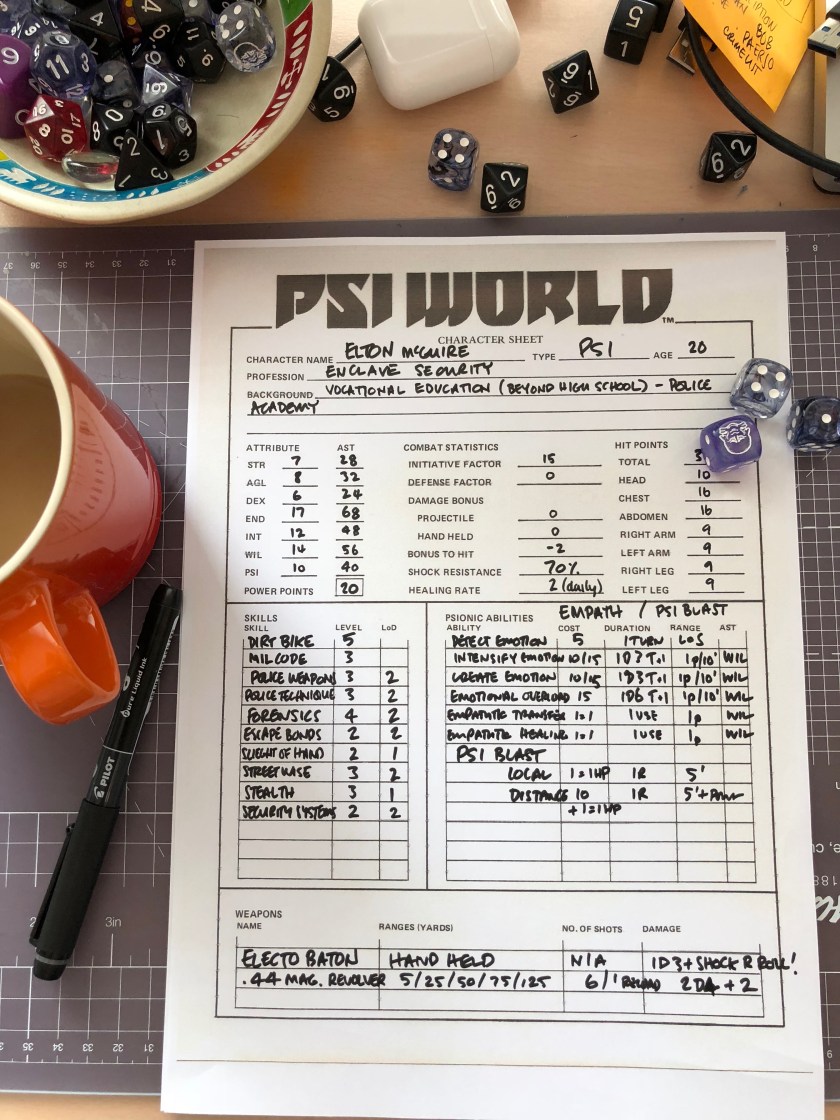
Meet Elton McGuire, an Empath Cop: “Do you feel lucky punk? I’ve got a feeling that you don’t”
Norms can get more ‘education’ therefore access to more skills. Still a bit boring though. Decided to give Julie a cool ‘MagJet Pistol’ to compensate.
One of the great aspects of the Golden Heroes podcast is discovering players around the world who have a fondness for the game. Jerry Nuckolls from Texas, for example, was impressed at the sight of the original, self-published edition, so I sent it to him. He’s going to write a piece for us, comparing the original rules with the Games Workshop version, until then, here’s a short video:
Episode 20 of the GROGPOD is coming later in April and is all about GOLDEN HEROES: a very smartly produced game that had a dramatic appearance, so I’ve made a short film to demonstrate the material.
I was very lucky on eBay. For £22, I managed to get everything that was produced by Games Workshop (in very good condition too), including all of the counters for all of the scenarios.
The piècesderésistance was the un-billed inclusion of the original A5 rules that were published by Simon Burley and Peter Haines. They would schlep these rules around the convention circuit back in the early eighties where they gathered a strong reputation for the ability to replicate scenes from popular Marvel and DC comics.
The game caught the attention of the Armchair Adventurers thanks to the great Brian Bolland cover for the first scenario pack LEGACY OF EAGLES. I ran the game with disastrous results (listen to the podcast for details). At ConVergence recently, we revived the game and had tremendous fun.
The podcast will be released in soon, until then, enjoy this short film.
The last time I played GOLDEN HEROES was in 1986 and it was the worst experience of my RPG life.
I’ll recount the story in Episode 20 of the GROGPOD (due in April, 2018), but it was that bad that I stopped playing RPGs for a while afterwards. ConVergence 17 provided a cure for my GMitis that I experienced at the beginning of last year, so I was confident that it would have a similar restorative effect on a deeper, more profound RPG wound.
I don’t mind admitting that I was pretty tense in the run up to the game. Memories of that ’86 experience kept resurfacing as I read through the rules. My anxiety wasn’t helped on the day by rail-replacement providing a similar nightmarish journey that I’d experienced on the way to Spaghetti ConJunction last month. I was 45 minutes late. Welcomed to the gaming table by slow hand-clap.
I needn’t of worried. I was amongst GROGSQUADers and they totally bought into the game and brought their own imagination and gaming insight to the adventure. It was cracking fun and I have a new found love for super hero games.
Here’s the play report, I’ve tried to avoid spoilers for the scenario as I may run it again at a convention near you…
The usual format : 5 peaks and one bum-note.
CHARACTER CREATION
Anyone who has played GOLDEN HEROES will know that part of the fun of the game is its random character creation. Although more modern games allow you to pick your feats and abilities, with GH, you have to spend points to get a roll on a ‘table of powers’ or on an ‘advantageous background table’ to generate your hero.
I didn’t want to lose this element of the game so, I created a card deck of powers and advantageous backgrounds and let the players to draw at random. They had 8 counters to spend on drawing from either deck or they could re-roll one of their initial attributes (which were strictly 3d6), or enhance an existing super power.
The character generation process was slick. Within 40 minutes we had seven heroes. The Players managed to pull together interesting and convincing origin-stories for them all too.
The Players got into the spirit of ‘comics code’ adventures
I provided a back story: they were part of a secret army that the monarchy had retained following the formation of Parliament. King Charles II secured this clandestine army and deployed them to protect the Empire and latterly the Commonwealth.
In a secret medical hospital in a remote part of Dartmoor, the King Charles Academy was founded, to enhance the army through experimentation and future tech..
One of the players coined the excellent team name:
‘THE IMPERIALS’
Intangible Man: a rich industrialist whose molecular structure was displaced through years of self-experimentation. His gravity manipulation was decisive in the final scene, preventing the Holy Grail plummeting into the depths of Hell.
Sub-Opitmo: A psionic grifter who inadvertently stole some of the future tech developed by Intangible Man’s company. The stolen glider was activated at the most opportune moment.
Mercuria: a wily, silver-skinned, indefatigable, super-fast agent who had adopted the properties of a super car that she’d stolen. Her ricochetting ‘steering’ wheel weapon was hurled at vital battle scenes.
Catalyst: Dr Colin Jervis a highly accomplished Chemist who was a director of the King Charles Academy. Probably better known for his years at Eaton, using molecular chemistry to enhance his right-hook in boxing. His famous ‘Sunday Punch’ is delivered with a cry of ‘It’s time for your Chemistry test!”
Captain SpyFly: Connected and ‘connected’ with a cyber-super-brain of valves and switches, the best that the sixties could offer. He was an agent in active service thanks to his chameleon ability to slip into the shadows.
Newton Einstein III: A psi-onic expert who provided temporary super powers to the team at their hour of need, but most notable for his phenomenal strength,
Professor Penn: Affected by his encounter with a Tibetan mystic and demonologist, he has insight into ancient ways and used his powers to conjurer fantastic beasts to do his bidding.
FLASHBACK!
The Armchair Adventurer rule is that every session needs to start with the characters hitting the ground running; in medias res. The adventure had a fairly conventional ‘you meet a wizard in the tavern’ opening (albeit the wizard is a cryonically persevered corpse of Queen Victoria and the tavern is the vaults in Buckingham Palace).
Therefore, I devised a scene ‘twenty one years before’ in 1963 where the Imperials are asked to stop a run away postal train, heading to London. The train is carrying high value packages and is being robbed by thugs ‘Buster’ and ‘Ronnie’ helped by Skyrider and Beacon (characters that come with the starter set).
It was a fun knock-a-bout encounter that they resolved through clever application of their powers and gave us all a feel for how the game works.
Queen Victoria and the Holy Grail was the second scenario pack published by Games Workshop and was written by Marcus L Rowland. It has a both a dungeon AND a dragon, but its old school credentials do not stop there. The scenario is on rigid tracks on a rail road so defined that it inspired the pre-credit sequence. There are many instructions to the Scenario Supervisor along the lines of “under no circumstances allow …” or “the players will not be able to do …”.
However, it does have a cracking set up, a great villain at the centre of it, some creepy elements, and a couple of cracking set pieces. Once things were loosened up a little, to meet modern sensibilities about player agency, it worked well.
DRAGON PUNCHING
What about jeopardy? That’s the issue with super heroes. That’s why the third act Marvel movies are so eye-poppingly disorientating – crash! bang! wallop! this has GOT to hurt!
The joy of this scenario is that the final scene is a dramatic climax, on the top of a famous London landmark, and it worked really well with all the characters having a decisive impact on the story.
Newton, a character that had been relatively quiet throughout, punched the dragon repeatedly with decisive blows. The villain was pushed into the very flames of Hell (even though the scenario said that she shouldn’t be killed). A very satisfying conclusion.
DIVISION
Spyfly’s cybernetic brain was working overtime attempting to decode the clues to unraveling the conspiracy behind the events. It would have been better deployed trying to calculate the division of damage. Divide it by eleven?
During the course of the six hours, I developed ‘mental arithmetic’ as a super power.
That said, overall, the rules played much easier than they read: fun, loose, the potential to send characters to the brink of incapacitation (in exciting ways) and emulated the genre very effectively.
Another ConVergence triumph. Thanks to Snowy and Kris for organising and to the players (Amy, Neil, Steve, Conrad, his mate Martin, Ian and Blythy) for making it such great fun. The GROGNARD file on GOLDEN HEROES will be released in April.