Asako Soh, a veteran GROGSQUADer, reflects on a year of gaming
Down the back of the armchair: My PODBOX in 2017

These newsletters have not been as regular as promised. My original intention was to provide recommendations for the GROGSQUAD based on my ‘consumed media’, however since I began late last year, my intake of media has reduced dramatically thanks to the imposition of other demands on my time. It isn’t likely to get any better until I retire from work, so it is best to see them as occasional treats for the next 16 years.
The chaps at Dissecting Worlds have hung up their headsets. I appeared on there as a frothing at the mouth RuneQuest zealot late last year. Keehar wants to spend more time gaming and donning his pads and box to play more cricket. In their final episode, Matt and Kehaar select their Desert Island podcasts. Keehar kindly took the GROGNARD files on board his ill-fated cruise ship alongside the evergreen Hypnogoria from the phenomenal Mr Jim Moon.
I’m always looking for new podcast to take with me on my daily commute. I thought that I would add a handful of my own recommendations based on my listening habits over the past 12 months.
GAMES
In my pod box there are the gaming staples:
The Good Friends of Jackson Elias: I think that this year, this podcast has matured into something very special. The quality of the content is second to none. I wholesomely recommend their recent episodes about Religion and Cthulhu: a challenging, thought-provoking and inspiring podcast encouraging CoC players to think more about the motivations of NPCs based on religious compulsion. This year they also had an episode dedicated to the World of Darkness universe which I found very informative. It was entertaining too as host Matt Sanderson tried to negotiate the minefield of the current licensing arrangements. Every episode plants the seed of an idea: highly recommended.
Cthulhu Breakfast Club: There’s something reassuringly English and jolly about this podcast produced by the fine folk of YSDC. Paul is an amiable host and there is joy to be found in his guests trying to avoid him descending into audio-quakery. The guests are plucked from the YSDC actual play stable, Finn and Val as well as TV’s Marty Jopson and HP Lovecraft Literary Podcast’s Chris Lackey. Sometimes the banter is lost on me and the “G and P numbers” debate (how many steps are you away from playing with Gygax or Peterson) out-stayed its welcome. However, most of the time it’s like being with friends exchanging views over tea and cakes. Subjects covered always have a Lovecraftian theme, the chat is light and knowledgable and it’s worth going beyond the paywall just to spend time in the company of Paul.
The Smart Party: I’ve always been a fan of this show since I saw them at DragonMeet alongside The Good Friends … There’s a definite sense that they’ve shifted up a gear since their 50th show released earlier this year, as their quality content has been coming out thick and fast. With the possible exception of Episode 61 when it stalled, the recent output has been very good: Ken Rolson, an actual play of Blades in The Dark and a call to players to up their game, have all been recent highlights.
Monster Man – a new podcast with a very appealing concept – host James Holloway going through The Monster Manual from beginning to end. Funny, full of suggestions and informative. They’re short, so subscribe!
Improvised Radio Theatre with Dice: I was pleased to finally convince Mike Cule to contribute an article to the latest GROGZINE. In this podcast, he and his co- host, Roger Bell West, have maxed out their wisdom score applying their experience in gaming to elucidate such subjects as tech levels, inspirational music and the RPG a Day. It appears like clockwork on the first day of the month, I measure the passing of my life by its appearance in my box.
Ken and Robin don’t need me to recommend them to you.
You know about all those though, don’t you? What about the others that I always listen to?
OTHER STUFF
This was the year that stopped listening to Mark Kermode’s film review. I don’t know why, possibly because my viewing habits have been changing over the years. There was a point this year where they were amusing themselves by playing the podcast at a slower speed and I thought that they’d reached peak ‘self-indulgence’ (note-to-self).
Big Mouth During ‘the naughties’ my favourite podcast was The Word magazine, co-hosted by supreme music journos Mark Ellen and David Hepworth. When the magazine folded, they continued the podcast sporadically as recordings of live interviews at The Islington pub. The recent one featuring Danny Baker is filled with his usual joie d vie, however I miss the knowledgable vibe and general hoary old chat from the original format. Producer Matt Hall and erstwhile The Word editor Andrew Harrison have attempted to restore the newsy feel in Big Mouth, a podcast that reviews the week’s cultural highlights. The tone is uneven as it is very much guest dependent, but it’s worth tuning in for Andrew’s turns of phrase and Matt’s inspired recommendations. As a starting point, I’d go for the most recent, and work backwards. You’ll be listening to St Vincent and buying comics in no time.
Thinking Allowed I know that there are many people who love In Our Time, Melvyn Bragg’s weekly history-thinking programme on Radio 4. I tend to pick and choose topics, but I make a point of listening to Laurie Taylor’s consistently interesting Thinking Allowed. Start with Mafia – Organised Crime.
Adam Buxton Podcast This is a charming, funny series which has provided the best individual podcasts of the year: Adam Curtis and Johnny Marr.
SMERSH Pod One of my recent discoveries, following the James Bond RPG episode, is SMERSH Pod, presented by John Rain and a special guest each episode which goes scene by scene through Bond movies. I’ve been working through the back catalogue and it is, without doubt, my favourite podcast of the year. It’s hilarious. As a starting point, try Moonraker with special guest Al Murray. It’s not all Bond, there’s a few Side Specials too: try out The Wild Geese.
Hopefully there’s something in this list to pique your interest. Please let me know your recommendations in the comments.
Episode 17 – Review of 2017 in RPGs

Intro: For this GROGPOD, we take a break from the usual format, instead of concentrating on a single subject, we are looking back at some of the experiences that we have had over the year.
Thanks to Phil the Dice Mechanic for his review
Groggies Pt 1: Our annual awards are determined by the random subjects written on the spurious envelopes. In this section we look back on the year in games mastering – some of the highs and lows – we award the Messianic Megalomaniac award for the year.
The Trial of RuneQuest: Earlier in the year, Dirk took the RPG Academy to Apple Lane. This is an edited extract. You can find the full version here and the you tube video here (if you really need to).
Groggies Pt 2: This is the Olive Kinnisberg Memorial Award for players, playing and players and the games that we play. There’s a mention of UK Games Expo, The Heroes Journey and Star Trek Adventures.
Postbag Pt1: Mark Hides has written a memoir of his experiences of RPGs in Sheffield. You can get his book here.
Groggies Pt 3 There have been lows as well as highs
Postbag Pt2 Rog Coe and Wayne Peters are regular correspondents to this site.
Groggies Pt 4 The new game that we have been playing and some of the hopes for the new year.
Outro: Thanks to Patreons and you’ll find details about the Spaghetti Conjunction here
1D6 No sleep ’til Five Eyes!
I think my ‘old-timer’ body clock is almost getting back into synch after last weekend when I participated in the 24 hour RPG charity event.
This is the fourth time that the event has been run, but the first time I’ve taken part. I was kindly invited by Tim from the Old Scroats, (see the UnEarthed Arcana part of the D&D podcast episodes.)
WarGames, the huge games store that can be found on swanky Lords Street in Southport, UK, were the generous hosts for the event.
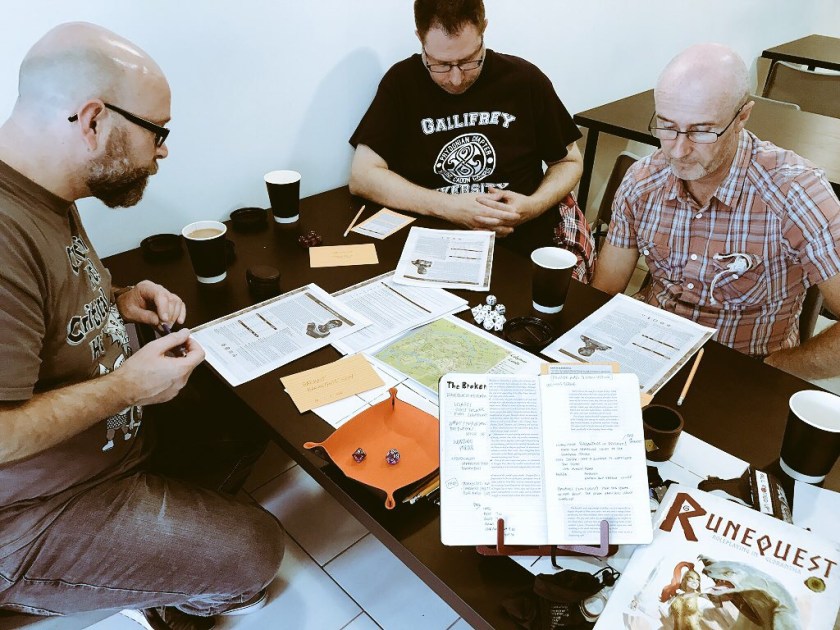
If you’ve listened to my appearance on The Smart Party podcast, you’ll know that I originally intended to run the new RuneQuest rules in Dorastor, however at the last minute, I decided to make things easier for myself and keep it old school: I ran the BorderLands campaign using the Classic RuneQuest rules.
I can run those games in my sleep, which is just as well as the plan was to run the game from noon Saturday to noon on Sunday.
The whole experience was tremendous fun and for a good cause too. So far, with the Just Giving account and cash collected, the event has raised a whopping £2281. Thanks to all the participants and the generous pledgers.
You know the format … 5 highlights and a fumble.
1.Once more, with character …

Rather than turn up with a fistful of pre-gens, we created the characters at the table (a session zero, if you will). The process took a little longer than I anticipated, but it allowed me to do a quick prima on Glorantha as well as the rules.
In the end, I think it was a good idea for the players to create their own characters as it allowed them to establish relationships and rivalries with the other players. There were a couple of siblings, for example, which meant that they looked out for each other more (jumping in the river to rescue a brother in distress), or they had deep rooted antipathy towards each other (“You are a coward brother!”).

2. RoneQuest

A party of six mercenaries gathered at the fort of Raus of Rone, ready to tame the wild lands and broker deals with the local beast-riders and other nomad tribes in the region. The fusty old Lunar Duke-in-exile plans to create a new colony of settlers from the North, but first, order needs to be brought to bare on new frontier.
The episodic format was perfect for the 24 hour long session as it was straight-forward, “go there, do that” mission based with a punitive contract that encourages the party to break the rules.
One of the players was a veteran of the BorderLands campaign, so he became Gerontiios, the right-hand man of Daine, the Duke’s sergeant at arms, (the lapsed Humakt Rune Lord and stoical NPC confident for the players.)
Gerontiios was bold, leading the unruly sell-swords, around the wilds of the Zola Fell valley. They encountered High Llama riders, dinosaurs, chariot-raced with Morokanth, battled with crocodile riding ducks and much more.
3. Gift from the Gods

This being RuneQuest, there were limbs flying and fumbles galore, but I gave them a little advantage. At the start of the game I gave them a packet of wine gums. This was their luck pool. They could use the sweets to reduce their roll so that a near miss could be a hit.
In addition, some of the players had been given extra rolls thanks to sponsorship donations. They came in handy at some crucial moments.
3. Multiverse

There were other games being played: Numenera, StarFinder and D&D 5e.
The GMs agreed beforehand that we would have a common theme of “an evil presence, breaking through the dimensions, aided by acolytes in the different Universes.”
An obscure symbol would unite the campaigns, to identify the influence of this cosmic evil as it attempted to penetrate the different realms of the multiverse.

Using ‘whats app’, we shared elements that had escaped from our games. Ethan sent “500 tonnes of rock and dirt from a plane,” from Numenera which manifested in Glorantha as a rain of silt which formed into a congregation of Whirlvishes – a vortex of sand.
I followed Baz & Gaz’s advice and had a group of rival mercenaries tormenting the PCs. The Sartarite bandits led by Rattle Poisionknife, a Sartarite bandit who had a tattoo of the symbol on his arm and was leading some of the locals towards his sinister faction, who were intent on awakening the dormant Nosferal.
At midnight, Gerontiios was sent on a HeroQuest to another table. He ended up in a dimension of sound in Numenera.
A nano from the Numenera game manifested as a purple duck at our table. He taught the Flintnail masonries how technologies of a ‘lifting device’ to help them in the construction of the Duke’s Fort. He defied being tied by a Waha rope by reversing his temporal existence.
Delirium began to set in at this point.
5. Five Eyes
“Avoid Five Eyes Temple,” Gerontiios commanded. Once they eventually went there, he was hit in the face with a manticore stinger and left for dead. Thanks to Divine Intervention (and a couple of wine gums) the Red Moon goddess revived him.
The River Horse temple had been taken over by the revived soul of Nosferal. The Newtlings were now undead servants in his thrall.
Despite his depleted power Gerontiios explored the far corners of the river caves and was possessed by a disorder ghost, who unleashed Nosferal from his tomb!

6. The 4am Wall (fumble)

By 4am, the esprit-de-corps was breaking down somewhat. 16 hours of play and things started to fray. They struggled to motivate themselves to reach the lofty heights of Condor Crags.
“What the hell are we doing this for? Why are we here?” they exclaimed. I’m not sure whether or not it was in character.
“We are all of us!” declared Gerontiios, rallying the band together to make the final push.
As dawn broke, the players found a second wind, an Orlanthi wind, which blew them towards a final confrontation with Nosferal, Rattle PoisonKnife, and the zombified bone-dragon Kerrang!
Their enemies were defeated thanks to the cypher recovered to Numenera (water from the River Styx) and a few remaining wine gums.

Episode 16 (Part 2) More Call of Cthulhu (with Mike Mason)

INTRO: A dedication to Carl T. Ford, the publisher/ editor of Dagon Fanzine.
GAMESMASTER’S SCREEN 00:02:20 (With Mike Mason) Mike faces the Keeper’s Screen to talk about Traveller, D&D and the all new Masks of Nyarlathotep (coming soon).
DAILY DWARF 00:40:00 @dailydwarf does an incisive assessment of the scenarios that appeared in White Dwarf. CURSE OF THE BONE was the winner of his 2015 Scenario Slam
JUDGE BLYTHY RULES! 01:00:00 We take a look at some of the changes in the 7th Edition rules.
OUTRO: 01:40:00 More news about the Patreon Campaign.
Episode 61 – The Grognard Files
Wiffle and waffle with the wise Baz and Gaz: the GROGNARD files, RuneQuest, Glorantha, 24 hour session (tips) and lots of other chatterage.
GROGMEET 2017 ScrapBook
In April last year, I sent out a speculative tweet, asking if anyone would be interested in meeting up in Manchester to play a game. Last time I did an advert like that, only Eddy and his mates turned up, this time it created GROGMEET.
Last year there were 8 games available, this time there was the opportunity to play 19 games over two days.
Thank you to everyone who attended, especially the Games Masters, without whom it wouldn’t be possible.
We also had a fundraising event to support the 24 Hour Game of RuneQuest that I’m running next week for Alder Hey children’s hospital. There were some very generous prizes provided by people attending and we raised £283.
I’ll let the photos speak for themselves. Until next year …
Adios amigos!
(Check #GROGMEET #GROGMEET17 #GROGMEET2017 for more great pics)
GROGMEET EVE


Episode 16 (Part 1) More Call of Cthulhu (with Mike Mason)

INTRO 00.00.16
We are returning to one of our favourite games, Call of Cthulhu, to consider what has changed for the game over the past 2 years, since the last episode.
OPEN BOX (with Mike Mason) 06.00
At the time of recording, Mike had just returned from his trip to NECRONOMICON and was fresh with the news of the great success for Call of Cthulhu at GENCON.
Mike shares his experiences from his formative years of role-playing and how his fascination with horror, drew him towards Call of Cthulhu.
ED’S BRAND NEW SHED 50.00
Ed is the first of us to hit 50 and his family have treated him to a brand-new metal shed. He talks us through his Fungi From Yuggoth scrapbook. You can get Mutable Deception from Drive Thru RPG.
GAMESMASTER’S SCREEN 01.08.00
We’re on a Jolly Boys outing – this is the player reflections on playing the Fungi … campaign.
OUTRO 01.33.00
We had many new Patreons joining us in September. Thanks to you all – sorry for mangling your names – we are very grateful for your contributions and look forward to making the ‘zine available in the next couple of months.
Blades in the Dark – with Iain McAllister
If you want a more detailed overview of Blades in the Dark – listen to Baz and Gaz chatting to @thegiantbrain on The Smart Party podcast
1D6 Blades in the Dark: a GROGNARD’s Guide

Mike Cule and Roger Bell West over at Improvised Radio Theatre with Dice podcast apply two criteria to any new game before it is introduced to a table of gamers. I like to call this the IMPROVRAD test, and it goes like this (I’m paraphrasing):
- The players MUST be able to understand their place in the setting with a very simple pitch. Why are they here? What are they supposed to do?
- A GM should only take on a new game if they are able to write at least six story hooks, ideas, NPCs quickly on a side of paper.
The first test measures the game’s ability to frame the context for the players so they can work with the material and the second is the GM’s test, to ensure that they can invent ideas on the fly, if needed, and can create sustainable game ideas to support the game in play.
Blades in Dark passes the IMPROVRAD test with the aplomb of a cold assassin.
If you need a pitch for your players, it provides it: Peaky Blinders meets Fafyrd and The Grey Mouser.
Not enough to get you hooked? Try this:
“You are daring scoundrels on the haunted streets of Duskwall, seeking your fortunes in the criminal underworld. Your legacy will be the gang you form in this dark city – the turf you acquire, the specialists you recruit, the scores you strike …”
That’s enough isn’t it? That’s enough to get your players intrigued and wanting to know more. I love the romance of The Godfather and The Lies of Locke Lamora, so it seemed the perfect setting for our group, with its promise of mechanics for pulling off daring heists and managing the escalation of a gang in a cut-throat world.
I’ve been reading the rules for the last few weeks and it is built on the shoulders of some of the Indy classics that emerged in the period of our deep freeze (1988 – 2010): Apocalypse World, Dogs in the Vineyard, The Burning Wheel and Fate, amongst others. The mechanics seemed perfectly intuitive on reading as they were completely congruent with the setting.
Ideas have been flowing, image on image, stealing NPCs and plots from the Sopranos and Fritz Lieber. Thanks to the handy tables at the back it’s possible to generate a thousand stories without really trying.
It makes the IMPROVRAD grade, but what is it like to play?
The format of one-d-six means that there are 5 highlights and a fumble:
What’s your playbook?

Characters are developed using ‘playbooks’ which are more like foundational templates rather than ‘classes’ as they provide a jumping off point for the players, so they can understand their current reputation in the city of Duskwall.
As emerging street-thugs trying to make a name for themselves, the player characters could be good in a fight (a CUTTER), a tracker who picks his fights (HOUND), a dabbler in alchemy (a LEECH) or they may play confidence trickster (SLIDE).
Predictably, my Magic-Loving-player (Blythy) went for the WHISPER playbook that reaches out to arcane powers and wrangles the ghosts in the city of DuskWall and my tactician (Eddy) went for SPIDER, a mastermind of criminal manoeuvring, “never get into situation that you can’t walk away from within 30 seconds”.
There’s a step-by-step guide that gives the opportunity to add narrative colour to the character back-story, but it’s not heavy handed. Going through this process allowed the setting to come alive for the players. They were intrigued by the strange lightening wall that blocks out the light and the strange forces beyond. They wanted to know more about the demonic levevithan beasts that are hunted for their electroplasm which fuels the city’s industry.
The structure …
I’ve played this twice and on both occasions, I’ve developed the story at the table, with no preparation before the session other than the suggested starting situation provided by the rules. This is the most improvisational mode I’ve managed to achieve since the 1980s when all of our games were constructed in the playing. I’ve never been a belts and braces GM, but this time, I wasn’t even wearing pants.
Thankfully, the mechanics help to support this free-wheelin’, so as a GamesMaster, you’re never completely off-road. The stories have a sequence of play that provide a loose, but important foundational structure
‘Free Play’ is the point in the session where the characters explore the world and encounter the colourful non-player characters. Out of these interactions, a potential ‘score’ will emerge, which will trigger the action scenes. Once completed, there is downtime when players can indulge in vices to reduce their stress, or spend coin to reduce heat or develop the assets of the gang.
New Resolutions
Despite my best efforts and the desires of John Harper, in these early sessions, it has been the mechanics that have driven the action rather than the fiction. Inevitably, for us old-time GROGNARDS, we were captivated by the novelty of the mechanics. Blades uses the idea of conflict resolution rather than task resolution. It was possible to hear the gears crunching as we navigated through situations. Instead of blow by blow we needed to understand what was at stake in a situation. The resolution rolls use pools of D6s where the likely result is “you succeed, but …”
Blythy did his usual flourish of the index finger, before settling on something on his character sheet, “I think I’m going to SEARCH.”
When I asked him to describe where he was going to search, how he was going to do it and to set up the scene, so we could agree on potential outcomes, he glared at me as if to say, “just let me, bloody roll for it.”
Flashback!

The opening situation (provided by the rules) places the characters in the centre of a turf war in the area of the city known as Crows Foot. The salt-of-the-Earth Lamp Blacks are in a face-off with the more elegant and organized Red Sashes.
The Whisper and the Spider had an audience with Bazso Baz, the leader of the Lamp Blacks, he had a mission for them, a chance to make their mark with a powerful ally by striking at the very heart of his rivals the Red Sashes. He wanted them to place a mysterious, rune-covered rattle-like device in the lair of the Sashes.
At this stage, the players opted for a ‘flash-back’ to a meeting with Mylera, the leader of the Red Sashes. The flashback is a clever device that prevents endless planning ahead of a ‘score’. The players crack on with the action, when they get to a point where they want to affect the result with some pre-planning, they can flashback to a scene where they set it up. For example, escaping through the window, they can flashback to the scene where they concealed ladders the night before.
In this case, they used the flashback to switch allegiances. In exchange for promise of hunting-ground turf within Crowsfoot and some protection from the Red Sashes, they laced a fine whiskey with poison.
Bazso could not resist the dram. Eddy’s character caroused him into drinking a salute to the deal. Thanks to a ‘devil’s bargain’ (an extra dice added to the dice pool) he scored a critical (two 6s) and Baz hit the deck.
In exchange for the bargain, the Spider is wanted. The Lamp Blacks have a long term project to seek out the mysterious assassin who killed their leader.
Faction Game – “Are you with me, or against me?”
The element that drew me to the game in the first place, was the ability to develop character AND your gang during the campaign. The crew becomes as important as the characters in the game, as you build up the alliances, rivalries, specialists, contacts in high places, scores, and turf.
Following the assassination, the escape from Baz’s ghost, and the general chaos generated, the downtime is a time when the book-keeping for the crew takes place. The Rattle Snakes were born.
Blythy and Eddy had an ambition to open a high-class house-of-ill-repute for reasons best known to themselves. The Red Sashes set them up with a Lair on the edge of Crows Foot. They’ve been planning and scheming their progression through the ‘Claims’ which acts like a track on a board that they need to move through and will determine the nature of the next heist.
They’ve also got this mysterious rattle to cause mischief.
Stop the clocks
One of its borrowed mechanics is the idea of ‘clocks’ or ‘pies’ as we like to call them. They are a way of measuring increasing jeopardy as the stress of failure builds up steadily. Situations can create clocks with segments determined by the GM. For example, Eddy’s Spider took a Devil’s Bargain (an extra dice) when he murdered Baz, so the Lamp Blacks have a long term project clocks that they are working on, to find the assassin.
The pies haven’t really got the player’s hearts racing yet.
Mechanically, there’s a lot of plates to keep spinning, as there are lots of different elements. A crude summary would be to see these factors as ‘narrative crunch’, but I don’t think it’s as simple as that: the structures and ‘gamey’ bits are the engine that allow the creativity to have a bit of a structure and provide the important motivation for the characters within the world. I suspect when we get used to the different aspects, the prominence of the pies will be more apparent.
Back in the day, we used to play long campaigns in cities. Since we began playing RPGs again in 2010, this is the most excited I’ve been as GM, and closest to reaching that special sweet spot that I thought we’d lost. It’s perfect for those time-strapped GMs who are willing to improvise. Once it’s mastered, it can generate great gaming experiences very easily.
When we were playing, it felt that we were discovering the places and characters together in a living world. It passes the IMPROVRAD test and the Armchair Adventurer’s test too: cracking fun.
Over on The Smart Party, they’ve just released a podcast about their experiences of playing the game. Give the original Bazso Baz a listen to find out more detail about this great game.